


Page 50 - EMCAPP-Journal No. 24
P. 50
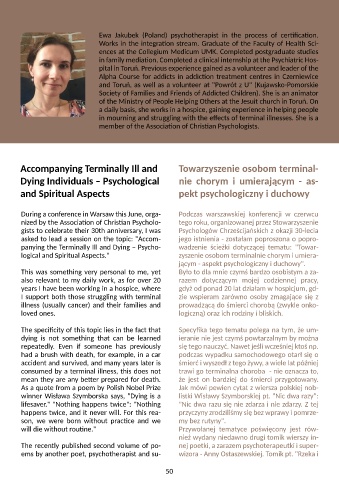
Ewa Jakubek (Poland) psychotherapist in the process of cer�fica�on.
                                    Works in the integra�on stream. Graduate of the Faculty of Health Sci-
                                    ences at the Collegium Medicum UMK. Completed postgraduate studies
                                    in family media�on. Completed a clinical internship at the Psychiatric Hos-
                                    pital in Toruń. Previous experience gained as a volunteer and leader of the
                                    Alpha Course for addicts in addic�on treatment centres in Czerniewice
                                    and Toruń, as well as a volunteer at "Powrót z U" (Kujawsko-Pomorskie
                                    Society of Families and Friends of Addicted Children). She is an animator
                                    of the Ministry of People Helping Others at the Jesuit church in Toruń. On
                                    a daily basis, she works in a hospice, gaining experience in helping people
                                    in mourning and struggling with the effects of terminal illnesses. She is a
                                    member of the Associa�on of Chris�an Psychologists.


        Accompanying Terminally Ill and                         Towarzyszenie osobom terminal-

        Dying Individuals – Psychological                       nie chorym i umierającym - as-

        and Spiritual Aspects                                   pekt psychologiczny i duchowy


        During a conference in Warsaw this June, orga-          Podczas warszawskiej konferencji w czerwcu
        ∑∑
        nized by the Associa�on of Chris�an Psycholo-           tego roku, organizowanej przez Stowarzyszenie
        gists to celebrate their 30th anniversary, I was        Psychologów Chrześcijańskich z okazji 30-lecia
        asked to lead a session on the topic: "Accom-           jego istnienia - zostałam poproszona o popro-
        panying the Terminally Ill and Dying – Psycho-          wadzenie ścieżki dotyczącej tematu: "Towar-
        logical and Spiritual Aspects."                         zyszenie osobom terminalnie chorym i umiera-
                                                                jącym - aspekt psychologiczny i duchowy".
        This was something very personal to me, yet             Było to dla mnie czymś bardzo osobistym a za-
        also relevant to my daily work, as for over 20          razem dotyczącym mojej codziennej pracy,
        years I have been working in a hospice, where           gdyż od ponad 20 lat działam w hospicjum, gd-
        I support both those struggling with terminal           zie wspieram zarówno osoby zmagające się z
        illness (usually cancer) and their families and         prowadzącą do śmierci chorobą (zwykle onko-
        loved ones.                                             logiczną) oraz ich rodziny i bliskich.


        The specificity of this topic lies in the fact that     Specyfika tego tematu polega na tym, że um-
        dying is not something that can be learned              ieranie nie jest czymś powtarzalnym by można
        repeatedly. Even if someone has previously              się tego nauczyć. Nawet jeśli wcześniej ktoś np.
        had a brush with death, for example, in a car           podczas wypadku samochodowego otarł się o
        accident and survived, and many years later is          śmierć i wyszedł z tego żywy, a wiele lat później
        consumed by a terminal illness, this does not           trawi go terminalna choroba - nie oznacza to,
        mean they are any be�er prepared for death.             że jest on bardziej do śmierci przygotowany.
        As a quote from a poem by Polish Nobel Prize            Jak mówi pewien cytat z wiersza polskiej nob-
        winner Wisława Szymborska says, "Dying is a             listki Wisławy Szymborskiej pt. "Nic dwa razy":
        lifesaver." "Nothing happens twice": "Nothing           "Nic dwa razu się nie zdarza i nie zdarzy. Z tej
        happens twice, and it never will. For this rea-         przyczyny zrodziliśmy się bez wprawy i pomrze-
        son, we were born without prac�ce and we                my bez rutyny".
        will die without rou�ne."                               Przywołanej tematyce poświęcony jest rów-
                                                                nież wydany niedawno drugi tomik wierszy in-
        The recently published second volume of po-             nej poetki, a zarazem psychoterapeutki i super-
        ems by another poet, psychotherapist and su-            wizora - Anny Ostaszewskiej. Tomik pt. "Rzeka i


                                                           50

