


Page 10 - EMCAPP-Journal No. 24
P. 10
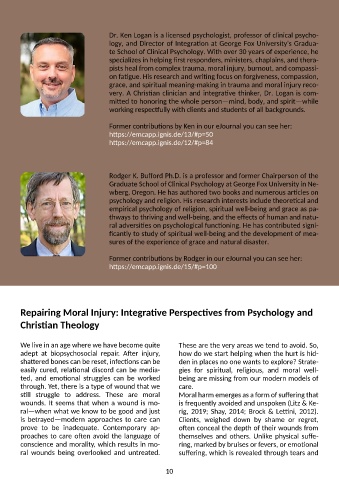
Dr. Ken Logan is a licensed psychologist, professor of clinical psycho-
                                       logy, and Director of Integra�on at George Fox University's Gradua-
                                       te School of Clinical Psychology. With over 30 years of experience, he
                                       specializes in helping first responders, ministers, chaplains, and thera-
                                       pists heal from complex trauma, moral injury, burnout, and compassi-
                                       on fa�gue. His research and wri�ng focus on forgiveness, compassion,
                                       grace, and spiritual meaning-making in trauma and moral injury reco-
                                       very. A Chris�an clinician and integra�ve thinker, Dr. Logan is com-
                                       mi�ed to honoring the whole person—mind, body, and spirit—while
                                       working respec�ully with clients and students of all backgrounds.


                                       Former contribu�ons by Ken in our eJournal you can see her:
                                       h�ps://emcapp.ignis.de/13/#p=50
                                       h�ps://emcapp.ignis.de/12/#p=84


                                       Rodger K. Bufford Ph.D. is a professor and former Chairperson of the
                                       Graduate School of Clinical Psychology at George Fox University in Ne-
                                       wberg, Oregon. He has authored two books and numerous ar�cles on
                                       psychology and religion. His research interests include theore�cal and
                                       empirical psychology of religion, spiritual well-being and grace as pa-
                                       thways to thriving and well-being, and the effects of human and natu-
                                       ral adversi�es on psychological func�oning. He has contributed signi-
                                       ficantly to study of spiritual well-being and the development of mea-
                                       sures of the experience of grace and natural disaster.


                                       Former contribu�ons by Rodger in our eJournal you can see her:
                                       h�ps://emcapp.ignis.de/15/#p=100


        Repairing Moral Injury: Integra�ve Perspec�ves from Psychology and
        Chris�an Theology


        We live in an age where we have become quite            These are the very areas we tend to avoid. So,
        adept at biopsychosocial repair. A�er injury,           how do we start helping when the hurt is hid-
        sha�ered bones can be reset, infec�ons can be           den in places no one wants to explore? Strate-
        easily cured, rela�onal discord can be media-           gies for spiritual, religious, and moral well-
        ted, and emo�onal struggles can be worked               being are missing from our modern models of
        through. Yet, there is a type of wound that we          care.
        s�ll struggle to address. These are moral               Moral harm emerges as a form of suffering that
        wounds. It seems that when a wound is mo-               is frequently avoided and unspoken (Litz & Ke-
        ral—when what we know to be good and just               rig, 2019; Shay, 2014; Brock & Le�ni, 2012).
        is betrayed—modern approaches to care can               Clients, weighed down by shame or regret,
        prove to be inadequate. Contemporary ap-                o�en conceal the depth of their wounds from
        proaches to care o�en avoid the language of             themselves and others. Unlike physical suffe-
        conscience and morality, which results in mo-           ring, marked by bruises or fevers, or emo�onal
        ral wounds being overlooked and untreated.              suffering, which is revealed through tears and


                                                           10

