


Page 42 - EMCAPP-Journal No. 24
P. 42
Comment


        This ar�cle offers an interdisciplinary explora�on of pain, highligh�ng
        its complexity and universality. The author rightly cri�ques reduc�onist
        tendencies in modern psychology and advocates for a holis�c approach
        that includes spiritual and existen�al dimensions. It challenges us to
        broaden our therapeu�c frameworks to help pa�ents move from diso-
        rienta�on to reorienta�on through suffering.


        Nietzsche and Jung’s sugges�on invites us to view suffering as a possi-
        ble source of meaning, as a tool for resilience and individua�on.

        The discussion on Schopenhauer and Stoic philosophy leads us to en-
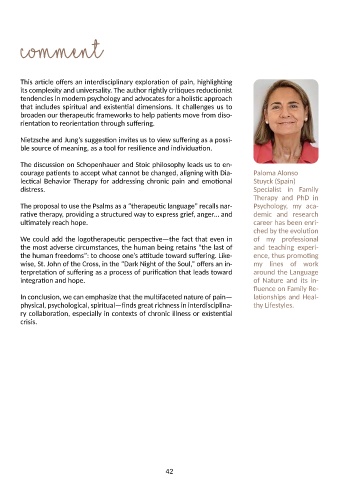
        courage pa�ents to accept what cannot be changed, aligning with Dia-              Paloma Alonso
        lec�cal Behavior Therapy for addressing chronic pain and emo�onal                 Stuyck (Spain)
        distress.                                                                         Specialist in Family
                                                                                          Therapy and PhD in
        The proposal to use the Psalms as a “therapeu�c language” recalls nar-            Psychology, my aca-
        ra�ve therapy, providing a structured way to express grief, anger… and            demic and research
        ul�mately reach hope.                                                             career has been enri-
                                                                                          ched by the evolu�on
        We could add the logotherapeu�c perspec�ve—the fact that even in                  of my professional
        the most adverse circumstances, the human being retains “the last of              and teaching experi-
        the human freedoms”: to choose one’s a�tude toward suffering. Like-               ence, thus promo�ng
        wise, St. John of the Cross, in the “Dark Night of the Soul,” offers an in-       my lines of work
        terpreta�on of suffering as a process of purifica�on that leads toward            around the Language
        integra�on and hope.                                                              of Nature and its in-
                                                                                          fluence on Family Re-
        In conclusion, we can emphasize that the mul�faceted nature of pain—              la�onships and Heal-
        physical, psychological, spiritual—finds great richness in interdisciplina-       thy Lifestyles.
        ry collabora�on, especially in contexts of chronic illness or existen�al
        crisis.


                                                           42

